This is my First Attempt at Writing a Biography, and it is for the Amazingly Wonderful Carla Sue Frieberg, Born February 9, 1955; AKA Carla Kelsey (1981); AKA Carla Cloud (1989); Until Her Death, June 5, 2021.
by John (Terry) Kosewic

Table of Contents
1) Early Years
2) Her First Jobs and Relationships
3) Carla's First Marriage - George Kelsey
4) Carla's Second Marriage - Charles W. Cloud III
5) Carla and I
6) Carla Leaves Chuck
7) Carla Finds a House
8) Snippets
9) Spirituality
10) Skinny Dipping
Forward
I met Carla in late 1989, and she came to work for me in September 1992. She continued working with me until COVID hit and she, understandably cautious due to her lung cancer, almost became a recluse. Almost everything I ever succeeded at was made possible by her never-ending help and support.
Her brother Tom once told me, “When we Friebergs work for a company, we treat that company as if it were our own.” That was especially true of Carla. I’m writing this biography as a way to try to pay her back. I want anyone who ever knew her to understand what she went through growing up, what she endured in her relationships, and how she became the wonderfully generous, strong woman I came to know and love deeply.
She helped everyone who asked—whether it was a Con-Soft or Mainstreet Computer Store customer on the phone, someone who walked through the door, one of my employees, or even one of Ko-Ri’s or my tenants. We became so close and bantered so well that many customers and tenants thought we were married. I eventually started saying she was my “work wife” and joked, “I have two wives now—Carla, my work wife, and Alena, my home wife—no benefits from either,” which usually got a chuckle from whoever I was talking to and a smirk from Carla.
At her memorial, her younger brother Tom had said, “I was talking to a fellow that knew Carla, and he said that she was `Good People’. I hope when I die, someone will say that about me.”
A friend of mine once said after talking with her for just an hour, “Carla is easy to love.” And it was true. Everyone I knew loved her—because she had the rare ability to connect with and befriend anyone.
As you read this, if you notice anything that’s incorrect, or if you want to add to the story—or share one of your own—please feel free to use the comments section or reach out to me directly. You can call me at (707) 778-3500 or email me at terry@kozyhomes.com. Anything I add after her second anniversary will appear in blue, so you can easily find the updated text without re-reading the entire page, although, just before her 4th anniversary, I ran it through Chat GPT for clarity.
Early Years
Carla was born on February 9th, in the year of our Lord 1955, in Ottumwa, Iowa. She was the third child of Mary Alice (Reighard) Frieberg, who was only 20 years old at the time. Her mother had her first child, John, at 17, followed by Frank, then Carla, and finally Tom, who was born two and a half years after her.
When we talked about her childhood, Carla only wanted to share the happy memories. She told me she couldn't remember anything else. Her favorite story was about the time her dad brought home a pony. The first child to finish chores or get home from school got to ride it. She laughed as she told me how her brothers, when they needed to pee while riding, would simply hang onto the reins and relieve themselves against a post. Every time she came back from using the bathroom, one of the boys would already be riding. It didn’t take her long to figure out how to do the same—pee against a post without letting go of the pony!
Early on, I often wondered why she never talked much about her childhood. One day, I noticed a scar on her shin and asked what had happened. She tried to avoid the topic, but eventually told me she’d been milking the cow too slowly, and her dad got upset. He kicked the bucket at her, and she ended up with a bad cut. Another time, while she was getting ready for her niece’s wedding, she asked me to help her clasp a necklace behind her neck. When I reached up to steady the chain with one hand on the front of her throat, she suddenly flinched and pulled away. I asked, “What did I do?” She simply said, “Never touch my throat with your hand.” I could only imagine that someone had tried to choke her at some point in her life.
After she died, I went through her phone to notify every contact. One of them, Marilyn (Fleig) Cannon, was especially close to Carla. They had grown up together, just ten days apart in age, and attended Libertyville Elementary School. Marilyn shared what she remembered: “When Carla was about 10 or 11, she wanted to run away from home—and I wouldn't let her go alone, so I went with her. We walked west down the gravel road and stopped at our apple tree. We each picked an apple and sat and talked, but we never got any farther. I don’t remember what made her want to run away, though I wish I did. If I ever get hypnotized, I’ll try to find out.”
Marilyn added, “Carla and her older brothers all scored 99s on the Iowa Basic Skills Tests every year—the highest score possible. Everyone knew they were highly intelligent. Carla’s mom, Mary Alice, was an angel—clever, witty, and could play the piano like an old-time ragtime player. At a school talent show, my mom made a papier-mâché horse’s head. Carla, being the shorter one, was the head, and I was the tail. Her mom played Alley Cat while we danced to it.”
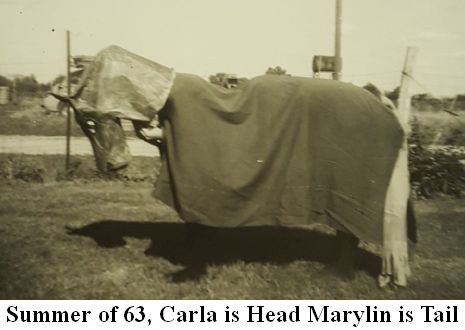
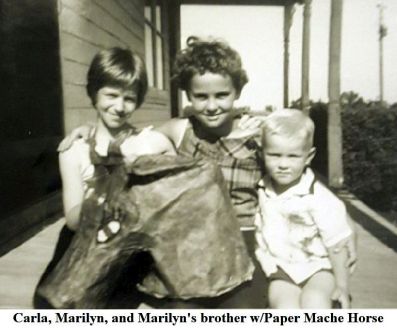
But the story darkened as Marilyn continued. She said that in the 1950s, in rural Iowa, wives were still considered property. As her next-door neighbor, Marilyn remembered hearing Mary Alice scream from a quarter mile away when Harold, Carla’s dad, beat her. When Tom was ten, Harold—likely drunk—threw him into a corn binder. That was the final straw. Marilyn’s parents, along with Mary Alice, made a plan. One day when Harold went to another county for an antique auction, Marilyn’s dad and older brother came with a pickup and cattle carrier, loaded everything Mary Alice and the kids needed, and moved them to Fairfield, Iowa. Carla started high school there, and from that point on, she and Marilyn drifted apart.
Her First Jobs and Relationships
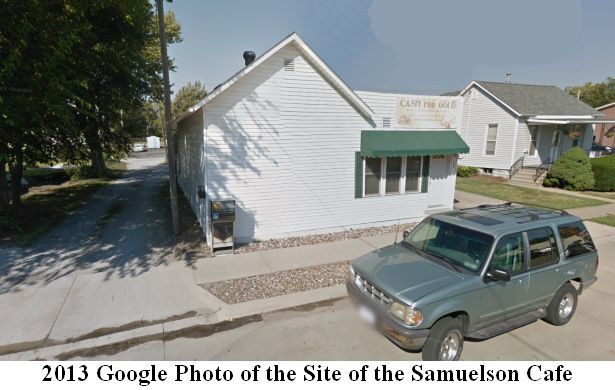
Carla told me she started working at 14, after school, with her friend Paula Becksfort at the local diner, Samuelson Cafe. That’s where she began learning the skills that made her a great waitress. It was likely also where she met the boys she dated at the time. She thought high school boys were too immature—not to mention broke—so she dated students from Parsons College, a nearby private school in Fairfield where wealthy parents sent their kids more to be rid of them than to educate them.
It was there she met Gary, an amateur photographer. In 1971, at just 16 years old, she left school and moved with him to San Francisco, California. They first lived somewhere in the Haight-Ashbury district. She once told me that when she had an interview for a job downtown in the Financial District, she didn’t know how the buses worked—so she walked over three miles to the interview in high heels! About a month later, she and Gary moved to an apartment complex in Mill Valley.
Shortly after, Carla lied about her age and got a job as a waitress at Denny’s in Corte Madera. It was there she met her lifelong friend, Darlene (Garvey) Conklin. I don’t know exactly when she and Gary broke up, but Carla once told me her relationships usually lasted about two years. She said she broke up with all the guys except for one—and even got back together with him just so she could do the breaking up!
Darlene told me Carla always fell for the "bad boys" and wouldn’t leave until she couldn’t take the verbal or physical abuse anymore. Sadly, that pattern is common in those who come from abusive homes. She may have been trying to fill the void left by her father—seeking love even when it came from someone who wasn’t good for her. More on that later.
After leaving Denny’s, Carla and Darlene worked at the Hungry House for a time. During that period, Darlene was dating a man named Ken, who took the photo of Carla at about 18 years old that appears at the beginning of this biography. Darlene said Ken once commented that Carla wasn’t conventionally pretty, but that she was “sexy as hell.” He also loved her deeply—something that may have contributed to the end of his relationship with Darlene.
While working at the Hungry House, Carla met a bartender named Michael who worked at Zim’s. Both John Baseheart and Darlene told me he was no good for her—they suspected he was a drug dealer or heavy user. She stayed with him until he punched a hole in her bedroom door. That was what it took for her to finally leave him.
After that, Carla and Darlene started working at Pier 15 in San Rafael, where they remained for about eight years. Darlene said after work, the "girls" would go out for drinks, and all Carla had to do was flash her signature smile to a few guys and they immediately had free drinks.
While at Pier 15, Carla got involved with her boss, Harry, who was about 30 years older than her. He adored her—treated her like a queen, introduced her to fine dining, and took her on trips to places like Reno and Las Vegas. He spoiled her with caviar, champagne, and escargot, and tried to show her the finer things in life. He also taught her how to “be a lady.” But even Harry had his boundaries crossed—he would run his finger down her back when she came to work to see if she was wearing a bra, since she often didn’t wear one under her white blouses. Eventually, she ended the relationship when she found out he was still married. She told me she never wanted to be "the other woman."
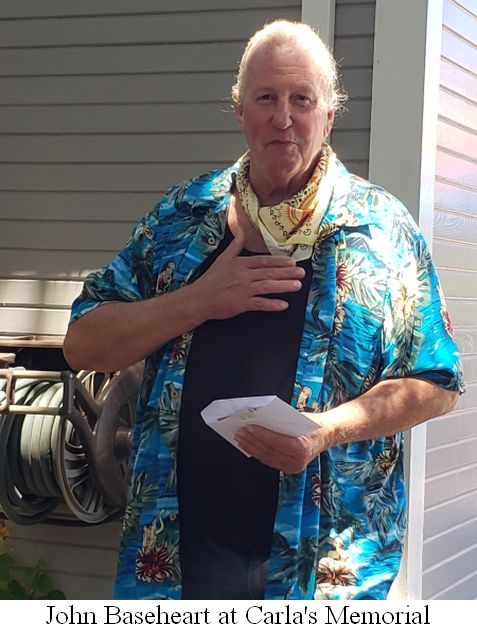
Around 1978, John Baseheart was working at his father’s bar in Novato, where Carla happened to be living. One day, while the bar doors were open, he saw her walking by and called out, “Free beer!” She turned around and came in. That’s how their relationship started. John told me he used to write poems for Carla because she loved them. Most were short—four or five lines—but every so often he’d write a longer one, similar to A Distant Light, which is included on her poem page. The photo above was taken by Carla’s brother Tom during her memorial service. John has since passed away, on July 1, 2023.
While living together, even while using contraception, Carla became pregnant. Sadly, she lost the baby. I believe that loss had a profound impact on her, especially later in life during her time with her future husband George. John said that after she lost her child, Carla began drinking more heavily—not just on weekends, but throughout the week. He also shared that during their time in Petaluma, she worked at Denny’s. Every day, she’d make him a chocolate milkshake with chocolate ice cream—just the way he liked it. But John said it all ended one day when he got mad at her and backhanded her. She packed her things and left.
Carla's First Marriage - George Kelsey
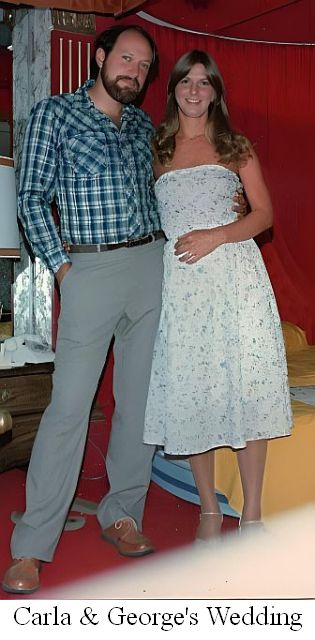
In December 1980, Carla met George Kelsey in a bar in Petaluma. George told me he’d stopped in with a buddy who needed to pick something up. He spotted Carla standing by the jukebox and, without much preamble, told her, “I don’t have much time—can I just get your phone number?” She gave it to him. He called, they went on a date the following weekend and hit it off right away.
They were enjoying each other’s company so much that George decided to stay with Carla through the weekend. On Monday, when he looked out the window and saw it was raining, he didn’t go to work. He stayed another day. And another. On Wednesday, when he finally returned to work, he discovered he had been fired. George jokingly blamed Carla for costing him his job—but I don’t think it was entirely her fault!
They married just eight months later, on August 29, 1981. George had two young daughters, and from the way Carla spoke about them, I sensed that she may have loved those girls even more than she loved their father. She practically worshiped them. I once asked George if they ever talked about having children of their own. He said they had, but he felt he already had two kids and didn’t want to start over.
I think that decision—combined with Carla’s loss of her first child years earlier, George’s reluctance to back her up when she tried to parent the girls, and her own deep insecurities—left Carla with the painful feeling that she had somehow failed as a mother. That guilt, whether justified or not, haunted her for the rest of her life. I believe it was one of the reasons she continued to drink more than she should have.
Carla often told me stories about their life together. She said she was a great cook, and George confirmed that—but with a caveat. He said she wasn't very good at first, but they took cooking classes together at Hardisty’s in Petaluma, and that’s when she became an excellent cook. He confirmed that she continued to work as a waitress during that time and used to ride a motorcycle from their house to where she could catch a bus to get to work.
In 1986, Carla left George. I’ve heard different reasons from different people. Carla told me it was because George wouldn’t support her in raising his teenage daughters—she had left home at 16, and she believed she knew how to help them avoid the kinds of problems she'd experienced. George, on the other hand, said it was because she wouldn’t quit smoking.
I have my own theory. I believe Carla desperately wanted to be a good mother, but never truly got the chance. That sense of missed purpose left a void that neither of them could fill.
At some point, after George got his contractor’s license, Carla started working for him. She even took accounting classes at night so she could be his bookkeeper. But ultimately, it wasn’t enough to keep them together. After she left George, Carla moved back in with John Baseheart, probably sometime in mid-1986.
By around 1987, she had started a new relationship with a man named Joe. I don’t know much about him yet—but I hope to learn more.
Carla's Second Marriage - Charles W. Cloud III
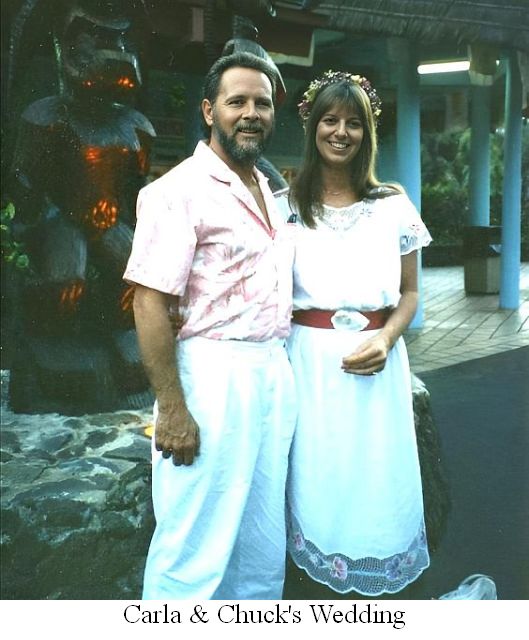
Carla met Charles Cloud at Andresen’s Bar in Petaluma in 1989. While I can’t remember exactly how long they dated, Carla once told me that whenever they were out at a restaurant or bar, strangers would often approach them just to say what a striking couple they were. After proposing, Chuck arranged everything for their wedding in Hawaii, and they were married on December 8, 1989, with his sister Pat and her husband Dan in attendance.
When they first got together, Chuck fancied himself a jeweler—he made belt buckles and other trinkets, which he sold at flea markets. He was also deeply in debt. Prior to this, Carla had managed to save a little money, so she used her savings to help him pay off what he owed. Not long after, he gave up on the struggling jewelry business and became a union crane operator with Dutra. He started earning real money, so she could once again start saving money, while they lived in a small condo they were renting in Rohnert Park. For a little while, things seemed to be going well.
In October 1995, Chuck and Carla bought their first home together: 4330 Gloria Court in Rohnert Park. Carla immediately began turning the house into a reflection of her own vision. She dreamed of remodeling the kitchen and spent months designing the perfect layout—an island stove, a retractable hood vent built into the island, granite tile countertops, and cherry wood cabinets. Around 2000, she finally had everything in place. She called her brother Tom, who came out from Wisconsin, and together we gutted the kitchen and rebuilt it exactly the way she had envisioned. We also converted the family room into a cozy dinette and turned an adjoining bedroom into a new family room with beautiful French doors.
But behind the beauty of their home, their marriage was troubled. I don’t know if Carla fully realized how much Chuck drank or how deeply insecure he was when they first married, but it didn’t take long for those things to surface. Shortly after their wedding, he demanded that she cut ties with nearly everyone from her life before him—Darlene, George, even George’s daughters, whom Carla loved like her own. When one of the girls was getting married years later, Chuck forbade her from going to the wedding. But Darlene told me they came up with a plan, and Carla managed to be there—though she may have arrived a little late.
Chuck wasn’t just controlling—he could also be abusive, both verbally and physically. One time Carla came to work with a visible bruise on her elbow. When I asked what had happened, she casually replied, “Chuck threw an iron at me. That’s where I got hit.” On another occasion, he either pulled a knife or a gun on her—Carla called 911, and Chuck ended up spending a night in a psych ward. He told the doctor that he didn’t get drunk often, so they let him go.
In November 2003, Carla contracted pneumonia. She was able to stay home and recover without hospitalization. During those days, she managed to quit smoking for six days. But when the weekend came and Chuck got drunk and began belittling her again, she stepped outside for a cigarette—her old coping mechanism. That was the longest she ever went without smoking that I was aware of. Back then, I didn’t understand how deeply tied smoking was to her need for emotional escape. It wasn’t just a habit—it was a lifeline, especially for someone who had grown up in abuse and learned to numb herself from pain.
In September 2005, they separated. Despite all of Chuck’s flaws, Carla loved him deeply. When he was diagnosed with pancreatic cancer in 2008, she was there, holding his hand as he passed away in August of that year. There are more details about this later in the story.
Carla and I
On June 26th, 1989, Carla and her ex-husband George Kelsey purchased my “Con-Soft” job costing and construction accounting program. The sale included training from my salesman, Jim. I remember Jim coming back and saying, “The lady who bought the program? She’s something else!” Jim couldn’t make the final training session, so he asked me to step in. That was the first time I met Carla. And Jim was right—she really was something else. I couldn’t quite put my finger on it—maybe it was her smile, her mannerisms, or just the way she carried herself—but something about her drew me in. Even though I felt an immediate attraction, I did my best to stay focused on the training.
After that, whenever she called in for support, I’d answer her questions... and then we’d just talk. About anything and everything. Later, she told me she felt like the program had been written just for her. It fit her needs perfectly and saved her so much time that she only needed to do George’s books one day a week.
To fill the rest of her time, she started helping out on job sites—cleaning up or running errands. But after she married Chuck, he didn’t want her working for her ex, so she had to stop. One day she called me and asked if I knew anyone else using the program who could benefit from her experience—whether by hiring her to do their books or training them to use it. She said she really enjoyed working with it and felt completely at home using it.
I made a few calls and lined up some leads. Alta Construction in Santa Rosa brought her on one day a week, as did Gordon Traub Electric in Sonoma. She also took a two-day-a-week job with Modular Construction in Napa to get them caught up, though she wasn’t thrilled about the forty-five-minute commute each way. Even after their books were in order, they kept her around for babysitting and house cleaning—jobs she didn’t particularly enjoy. I eventually found her a part-time gig with a small electrical contractor in Rohnert Park, but that was only four or five hours a week.
By August of 1992, my bookkeeper, Muriel, had given notice—she was moving back to Wisconsin. I called Carla and asked if she’d be interested in working for me. She said she’d think about it. Eventually, she said yes. On September 1, 1992, Carla officially joined my team, part-time—just two to two-and-a-half days a week.
She was a natural with people—warm, respectful, and kind. She made a fantastic customer support rep, not only because she knew Con-Soft inside and out, but because she genuinely cared about the people she helped. Over time, she knew almost everything about our customers. I remember overhearing one of her calls, where she and another woman laughed about the final prompt on the screen after entering data: “Are you satisfied (Y/N)?” Carla joked, “What if the entries are correct... but I’m not satisfied?” They both cracked up.
She had that kind of connection with everyone—including customers of the Computer Store. She was so engaging that our workers’ comp auditor, who was only supposed to come by once a year, started dropping in every couple of weeks just to say hi and chat. George, her ex-husband, would stop in when he saw her truck. So did friends, clients, and other regulars.
Carla’s willingness to handle whatever came her way gave me back something I hadn’t had in a long time: time itself. Because of her, I no longer had to work seven days a week, twelve to fourteen hours a day. She lifted a weight I didn’t even realize I’d been carrying.
By January of 1995, Alta Construction had retired, and Carla added that extra day to her schedule with me. During her three and a half workdays each week, she managed a remarkable workload. In addition to providing Con-Soft customer support, she kept the computer store staff on track, handled weekly payroll for Kozy Homes’ six employees, and managed tenant issues—both for the apartments above the store and the three units I owned in San Francisco. She also took care of all the bookkeeping for each company, including preparing the sales tax reports for the computer store.
Because of Carla, my wife Alena and I were finally able to take our first "real" vacation in nearly ten years. We spent four weeks in Europe that April. I had hoped that this time away from work would help repair our relationship, but sadly, it didn’t change much. Alena was deeply unhappy with how much I prioritized work, and how little I seemed to respond to her needs in our marriage.
Sometime in late 1996 or early 1997, Alena and I were having a conversation when she said something that caught me completely off guard: “You must really love Carla.” I was surprised and asked her why she thought that. She answered simply, “Because she takes such good care of you.”
Her words stuck with me. As I sat with that thought, I realized she was right—Carla did take care of me. She took care of the business. She kept everything running smoothly. Without her, I wouldn’t have had any time to breathe. No one else ever stepped up the way she did.
Could I love her? I had never really asked myself that question. I knew I admired her deeply—she was beautiful in mind, body, and spirit. She was also my best friend. We talked about everything: our childhoods, our past relationships, our frustrations, our dreams. We even tried to help each other navigate our current relationships—me with Alena, and her with Chuck. But still, love?
A few minutes after Alena's question, I told her honestly, “I don’t know. I’ve just never thought about it.” But as the days passed, I began to reflect more. And slowly, I came to understand that I did love Carla. At first, I told myself it was the kind of love you have for a sibling—deep, loyal, protective. But maybe... it was more than that.
Then one day, an old girlfriend dropped by the store and said something that shook me. She told me Carla had feelings for me. That she could see it in the way Carla looked at me, the way she talked to me. I couldn't believe it. How could someone like Carla—so capable, so kind, so remarkable—ever feel that way about someone like me? I felt like a failure. I couldn’t make my wife happy. The computer store was losing money. I couldn’t pay Carla what she was worth. My construction projects barely turned a profit. If Alena didn’t work her thirty-two hours a week, we’d be broke.
There was just no way Carla could feel anything more than friendship. I only hoped I wouldn’t somehow mess things up between us and lose the best friend I had ever had.
Around that time, a close friend encouraged me to take a class through Rapport International. She said it had helped her relationship with her husband and thought it could help mine with Alena, too. She also believed it might help me grow as a person—and as an employer.
I took the class in early December of 1997. I ended up learning three major things about myself. First, I didn’t know how to play. I had worked every summer and weekend growing up with my dad, and I had never really learned how to just enjoy life. Second, I discovered that I would rather die than ask for help—a mindset that nearly cost me my life a year later. Third, and perhaps most eye-opening, I realized I had a deep need to be liked, so strong that I couldn’t bring myself to fire someone even when it was absolutely necessary.
As for being a better employer, the class taught me something simple but powerful: say “thank you” more often, praise good work, and show appreciation.
When I returned to the store, I thanked all the employees—and for the first time ever, I hugged Carla. I also told her how much I appreciated everything she had done. To show that appreciation, I started taking her to lunch twice a month. We began going out every other Thursday starting that January, and sometimes Alena would join us when she could. It gave her a chance to see more of what I already knew and loved about Carla.
That spring, I had to lay off two Kozy Homes employees. A couple of months later, Carla came to me looking downcast. She said, “I forgot to take the two employees off the group health insurance, and we paid about a thousand dollars more than we should have. I'm sorry. I’ll pay for the mistake—I’ll take it out of my pay.”
I told her, “No. It was an honest mistake. I’ll find the money somewhere. You’re not allowed to pay for it.”
But since she wrote her own paycheck, she ignored me. Quietly, she began deducting small amounts from each pay period so Chuck wouldn’t notice. She paid back the full amount herself. How could I not love a woman with that kind of integrity?
By August I was still working on a duplex that I bought in 1995, and Carla stopped by to check on the progress, as she often did. We didn’t yet have stairs at the front—just a few 6x6s stacked like makeshift steps. I reached out my hand to steady her as she climbed up. When she reached the landing, I let go. But she held on a moment longer before finally releasing my hand.
That one extra second sent my mind spinning. Was my old girlfriend right? Could Carla actually have feelings for me? I didn’t know what to think.
About a month later, we were driving to San Francisco together to install a network for a nonprofit using space in San Francisco General Hospital. While crossing the Richmond–San Rafael Bridge, the sunlight hit her face just right, and I was struck once again by how beautiful she was. I couldn’t keep quiet any longer.
“I think you’re very pretty,” I said. “And I feel a deep attraction to you.”
She didn’t respond. Not a word. No reaction at all—as if I hadn’t spoken. The rest of the drive passed in silence, and I was left wondering: Did she hear me? Was she just ignoring what I said? We spent the day working, but it was like the moment never happened.
The next day, we drove in again to finish the job. As we crossed the same bridge, I looked at her—still seeing that same beauty, still feeling everything I’d felt the day before. I couldn’t hold it in.
“I’m sorry,” I said. “But I have to tell you—I love you. I can’t keep it a secret anymore. You’re just too beautiful, too helpful, and too kind.”
Again, no response. Not a glance, not a word. It was as if she hadn’t heard me at all. We finished the work in silence. On the drive back, my heart sank. I was sure I had ruined everything—our friendship, her job, all of it. I felt like a fool. What was I thinking? We were both married. We loved our spouses. I’d crossed a line, and I feared I’d lose the one person I relied on more than anyone.
But she came to work the next day like nothing had happened. Time crawled after that.
Then, almost two weeks later—on the first Thursday in October, our regular lunch day—she said, “Can we go to Sonoma Taco for lunch today?”
“Sure,” I said. “Anywhere you want.”
She asked if we could walk—about a quarter mile—because she wanted to talk. My stomach sank. I was sure this would be our last lunch together. I was certain she was going to quit
.But to my surprise, the opposite happened.
As we walked, she began to speak. She told me how she had been attracted to me from the very beginning, ever since I handed her an update disk nine years earlier. She said I was on the phone doing support, and just handed it to her without even noticing her—and somehow, that only added to the attraction. She remembered how patient I was during her training sessions, even when she asked what she thought were stupid questions. She thought I was smart—brilliant, even—because the program did exactly what she had hoped for.
Then she told me how difficult it was to accept the job offer back in 1992, because she was afraid her feelings for me would be obvious. And finally, she said that she had loved me since 1993—and that it only took me five years to notice.
I laughed and said, “That’s not entirely true—I didn’t notice at all! I only know now because you told me. I had some hints along the way, like someone telling me you liked me. But I decided I loved you in 1996, and it took me two years to work up the nerve to say anything. We’re both married, we both love our partners... and you know I can’t read people.”
When we returned to the store, I wrote her a note. I was over the moon to know she loved me, but the reality still stood: we were both committed to our marriages. So, I wrote, “I don’t think it’s a sin to love each other—as long as there’s no sex. So please, let’s keep it that way.”
She agreed. A few years later, as our bond deepened, we made a promise to God—no sex. And we kept that promise.
By 2000, we were both under immense stress preparing the Y2K update disk. The long hours spent working together only deepened our connection. It seemed like Chuck and Alena understood the pressure we were under and accepted it. Still, the closeness that came from that time together made our bond even stronger.
That summer, I reluctantly took on a remodeling job in San Francisco—a sizable addition for some friends, who also happened to be my attorney. I say “reluctantly” because taking the job meant giving up my cherished sunny weekday beach trips. But I needed the money to finish work on the duplex I’d bought back in 1995.
During that time, Joanne and I had many deep conversations. She gave me a copy of Conversations with God. I found it thought-provoking, and in April 2001, I decided to attend a Cursillo weekend—a "short course in Christianity"—that my brother-in-law had gone through back in 1974 and described as life-changing. He was right. The experience opened my heart to just how deeply God loves us—even when we fail Him.
I wanted both Alena and Carla to experience what I experianced. I thought convincing them would be easy. It wasn’t. Alena finally went in 2006, and Carla in 2007. (More on that later.)
In 2002, my cousin Annia came from Poland for a six-month visit. She was eager to help and came to the computer store every day. She and Carla became fast friends. Carla would affectionately introduce her as her “little sister” or “daughter,” since Annia was 22 years younger. They became so close that they took two road trips together to Wisconsin over the years.
In 2003, one of our employees told Carla he was struggling with his vision. She quietly did some research online, matched his symptoms, and insisted he stay home and see a doctor. He returned a few days later with a diagnosis: type 2 diabetes. Carla didn’t stop there—she went out and bought a wide variety of low-carb foods to help him and his wife get started on a new diet. That was Carla—always thinking about others.
When my father passed away in January 2004, his family came to the funeral and asked to meet “this Carla” they’d heard so much about. Apparently, he’d often come home from work and tell his wife and the kids, “Today, Carla said this…” or “Carla said that…” Like I’ve said before—she helped everyone.
September 2005, Chuck, Carla, and Annia went to Mendocino for the weekend. Coincidentally, I had an overnight Cursillo team meeting in nearby Fort Bragg. Carla and I agreed to meet at 3:30 p.m. so I could take Annia home with me.
I arrived a few minutes late and didn’t see her truck. After failing to reach anyone by cell phone, I began searching nearby. After 15 minutes, I figured they’d already left and decided to catch up with them on the winding road back to Cloverdale. I was upset—frustrated that Carla didn’t wait even two minutes.
Thankfully, Carla was driving slowly. After about 45 minutes, I caught up with her. When she saw me in the rearview mirror, she pulled over, and both she and Annia got out. I asked, perhaps a little too sharply, why she hadn’t waited. She didn’t respond—she didn’t want to upset Chuck. Annia gathered her things and got in my van. I drove off in a huff, still feeling hurt and confused.
Later that evening, once they were back home, Carla called me. She told me that Chuck had forced her to leave at 3:15 because he was already drunk. When he saw me pull up behind them earlier, he became furious. He didn’t like my tone or how I had spoken to Carla—or how I drove off. He told her, “No one talks to my wife that way.” Then he gave her an ultimatum: she had to quit working for me. He said he’d come pick up her final check and anything she’d left at the office. She was never to see me or speak to me again.
Carla was terrified that he might try to harm me. She warned me to be careful.
Annia and I had a water heater to install that night, so we didn’t go home immediately. By the time we finished, Chuck had given up looking for me and gone back home.
Carla Leaves Chuck
By Tuesday, Carla and I had worked out a plan for her to leave Chuck and move out of the house that Thursday. We got her a P.O. Box, rented a storage unit nearby, and changed her phone number.
Thursday morning, after Chuck left for work, my friend Bill showed up with his pickup, I brought my van and small trailer, and we moved quickly. We picked up the furniture she wanted—like the buffet she had lovingly refinished and her bedroom set—and filled the storage unit. All her personal things went into her truck. She left Chuck a letter explaining why she was leaving, then drove to my dad’s vacant house in San Francisco.
About a week later, she called Chuck to see how he was doing. As he often did when sober or nearly sober, he apologized for how he had treated her throughout their marriage and asked her to come back. But this time, she stood her ground. She said no.
After two months, she felt safe enough to return to work and move back to Petaluma. She found a small two-bedroom house on Laurel Street, and I helped move her in. She and Chuck filed for legal separation and began handling their finances independently.
In spring of 2006, she and Chuck agreed to sell the house on Gloria Court, since the housing market was beginning to fall. A pest inspection revealed dry rot and termite damage. Carla hired a contractor—one who wasn’t great—but coincidentally, his carpenter turned out to be her old boyfriend, Joe, whom she had dated between George and Chuck.
Joe did good work. After finishing the exterior, she asked him to work on the inside of the house during his spare time. When he was done, I hired him to work for me full-time.
In February 2007, I took a clothing-optional cruise around Carla’s birthday. While I was gone, I found myself worrying—wondering if Joe might try to rekindle something with Carla. After all, she and Chuck were separated. Joe could easily take her out for drinks after work, drive her home—all the things I wanted to do but couldn’t.
During that time, Carla and I misunderstood each other’s emails. She misread a few of my messages as “backhanded compliments.” That was when I wrote the poem Where Beauty Abounds. She told me it made her cry. She promised never again to misread my words or assume hidden meanings that weren’t there.
When I got back from the cruise, she admitted she had kissed Joe—out of curiosity, just to see if anything was still there. But she said there wasn’t. It was, in her words, “a nothing kiss.” Joe left the company not long after that.
In April, Carla experienced her Cursillo weekend. It didn’t impact her as strongly as I had hoped, but it did inspire her to begin attending Open Door Church in Petaluma regularly. She eventually became a committed parishioner.
That August, I needed help at my daughters place in Moses Lake. Both Alena and Carla offered to come, but I said I could only have one of them. The last time they were both there, over the Fourth of July, I had spent more time coordinating their activities than doing the work I needed to do.
Alena didn’t trust me being alone with Carla and insisted that if Carla went, she had to come too. I said, “I don’t care which of you comes—just one, please.” In the end, Alena told Carla to go, since Carla had more flexibility and Alena had to care for our dogs.
Carla arrived that Sunday afternoon. My friend Bill came in on Tuesday afternoon, and Carla left on Wednesday.
Later, Alena told me that after Carla had driven off to Moses Lake, she went into the backyard, cried, and prayed. She said she felt a peace wash over her—something she’d never felt before. As if God was telling her, “It’s going to be OK. You don’t have to worry about him and Carla anymore.”
After Carla’s house was sold, Chuck bought a condo and asked her to help him fix it up. At the same time, I was still in Moses Lake and managing the sale of one of my dad’s properties. With no internet there, I relied on Carla for updates and information.
She was supposed to be working from 9:00 AM to 4:30 PM. One day, I called at 3:30—she wasn’t there. Charles said she had gone to pick out tile for Chuck’s bathroom. That night, I called her and asked what happened. She gave me an excuse.
I told her I needed to be able to count on her during work hours, and if something came up, I expected advance notice. Two days later, I called at 3:00 with urgent news from my nephew about a new, lower offer on the property. Again, she wasn’t there. She had gone to meet the tile guy—on my time.
I was angry. I called and told her we needed to talk. I reminded her she had promised not to prioritize Chuck over her job with me. She explained that it was the only time the tile guy could meet, and she hadn’t been given notice either.
I asked her, “If the tile job turns out badly, who’s Chuck going to blame—you or the tile guy? And if it turns out great, who’s going to get the credit?”
I told her, “You know Chuck doesn’t respect what you do for him. He just uses you. I respect everything you do for me—but not this.” I told her I loved her, that I didn’t want to be angry with her, and that maybe the best solution was for her to find a replacement for herself at work. That way, she could help Chuck as much as she wanted, and I wouldn’t be caught in the middle.
Then I hung up. Afterward, I called Charles and told him not to build any more computers—just repairs. I told him I’d be closing the computer store in six months.
Later that night, Alena called to see how I was doing. I said, “Not good. I fired Carla. I’m closing the store. This isn’t a good time to talk.” She asked if I was upset with her too. I told her we’d talk later.
About a half hour later, Alena called back. She said, “I need to know now—what should I expect from you?”
I told her, “I want a divorce.”
She asked why. I said, “I’ve been asking you to go to marriage counseling for fifteen years and participate. You went but never accepted any of the blame for our problems. Everything was always my fault. I’m tired of walking on eggshells.”
She asked if there was still a chance to save our marriage. I told her, “You’d have to find a counselor and be willing to go—even if it means admitting you were wrong.”
She said she would.
Later that evening, Carla called. She told me she had been crying ever since she left Chuck’s house. She said she was sorry—she hadn’t expected me to react the way I did and hadn’t realized how deeply she had hurt me.
She told me I was right: if the tile job had gone poorly, Chuck would have blamed her, and if it turned out great, he wouldn’t have given her any credit. She had told him as much. Then she laid it out clearly—if he wanted her help, it had to be on her terms. Otherwise, he could find someone else.
She said she loved her job and didn’t want to risk losing it for him. He agreed to let her help when she could and promised not to be so demanding.
Carla then promised me she would work forty hours a week until she was caught up. That meant working from 9:00 to 5:30, or 9:00 to 4:30 with an extra five hours on Saturday. She told me she would do whatever I needed.
I told her, “Whatever works best for you—just as long as I know when I can count on you. I don’t have internet here, and I depend on you for answers I need.”
She kept her word, at least for a while. For the first few weeks, she worked a full forty hours. Eventually, she started to slack off again—but this time, it wasn’t for Chuck. It was for herself.
Carla Finds a House
In November, while I was still working in Moses Lake, Washington, Carla called to tell me she had found a house for sale—an 1890s three-bedroom Victorian, about 1,600 square feet, with nearly an acre of land and 4,500 square feet of outbuildings. It was close to town and listed for $550,000. I told her to call our realtor and take a look.
After seeing it, she said she really liked it and thought it would work well for me. She added that if she could rent it as-is for the same amount she was paying for her tiny two-bedroom, 600-square-foot house, she would take on the renovation herself. I agreed. Without me ever having seen the place, she wrote a $10,000 deposit check and signed the purchase contract.
Alena saw the house and said it was nice—but she didn’t want me to buy it. She was afraid I would end up spending all my time there with Carla. At that point, Alena and I were still in marriage counseling with the counselor she had chosen, and we were making some progress. She brought up her concern during a session. The counselor asked me why I wanted to buy the house. I explained: it had land, usable barns, a house Carla was willing to rent as-is, and I could buy it outright with money from my dad’s estate—no loan required.
Later, the counselor asked me privately, “Do you love Carla?”
I said yes. But I made it clear—there was no sex.
She asked if buying the house would change my relationship with Alena or with Carla.
I said no, it wouldn’t. If you would like to see photos of the exterior, click here.
The sale closed on December 7, 2007. The first thing we did was empty Carla’s storage unit and move her things into the best barn to help her save money. I told her the house was in such bad shape that she couldn’t move in yet—we had a lot of work to do.
I applid for a permit to do a voluntary earthquake retrofit, and we started immediately. The plan was ambitious: remove all the original trim without damaging it, strip the lath and plaster from the exterior walls, remove the wallpaper inside, bolt the frame to the foundation while leveling the floors, rewire everything, redo the ducting, replumb the water supply, insulate, sheetrock, tape, and paint—all by February 1st. We needed more help, so I hired Joe again. To see photos of the interior, click here.
Then in mid-January 2008, Chuck was diagnosed with pancreatic cancer. Carla began spending much of her time helping him, which pulled her away from working on the house. As a result, we couldn’t finish it by our February 1st goal. It took two or three more weeks before she could finally move in.
Not long after that, it became clear that Chuck didn’t have much time left. By mid-May, he moved in with Carla—a situation that wouldn’t have been possible in her previous rental, which was far too small. They set up a hospital bed in the living room, and Carla cared for his every need.
We emptied Chuck’s storage unit into one of the barns, and he signed the deed to his condo back over to the bank. Housing prices were still falling fast.
When Alena saw how much Carla loved and cared for Chuck, it softened some of her fears about us. In August 2008, Chuck passed away, and Carla was grateful to have been there, holding his hand as he died.
After that, something shifted. Alena began to warm to Carla. They actually started talking—and even commiserating. Carla would complain to Alena about me just as much as Alena had always complained about me to Carla. It gave them some common ground.
Final Note:
More to come when I have time to write—I'm a slow writer. But before I forget: after we moved Carla into her new office in 2015, a friend of mine stopped by to say hi. During their chat, when the topic turned to me, Carla just rolled her eyes and said, “Terry will never change!”
Snippets
Short Stories That Don't Necessarily Fit Into A Timeline Or Stories From Other Firends Of Carla
In late May of 2014, I was working after hours on a ceiling that was thirteen feet high. I was perched on an eight-foot ladder, taping the sheetrock, when suddenly... I wasn’t. I fell. Straight onto the concrete floor. My leg slammed into a five-gallon paint bucket on the way down, just to make sure the incident was memorable.
I lay there, not moving, partly because I was in pain and partly because I was afraid something important might be broken—like a bone, or my pride. I still had my cell phone, so I called my wife. No answer. I called Carla, who lived just a mile away. She rushed over to be my hero, but full of panic.
When she saw me sprawled out on the floor, she immediately went into full concussion protocol. “Are you OK? Does your head hurt? Do you have double vision? Can you see clearly?” she rapid-fired, barely pausing for breath.
When I finally got a word in, I groaned, “Yes, I hurt. And yes, everything is blurry.”
Knowing she was worried about a head injury, I couldn’t resist messing with her just a little. “Can you find my glasses?” I asked, as seriously as I could manage.
She found them, handed them over, and I put them on. “Oh wow,” I said, “I can see just fine now."
She gave me a look that said she was half-relieved, half-ready to kick me for scaring her like that.
The folowing story is by Mary, a tenant
I met Carla Cloud when I moved into my apartment almost 16 years ago. She was the property manager, and she showed me the space and went through a very lengthy lease agreement, before she happily gave me my keys. She took her job seriously, and was a stickler for the rules, but I liked it that way. I always knew I could go to her or her boss, John, at anytime and my issues would be quickly resolved. There was such a palpable warmth about her, though. I felt it right from that initial encounter, and I knew we would be fast friends. And that we were! We could talk on the phone for hours, and we laughed so hard-all the time! She felt like home. Like a friend I had known forever. Carla was just such an amazing woman with so much to give, and so much to live for. She was truly happy with her life, and she wanted to make other people happy as well. She also had a great relationship with my Labrador, Splash. He adored her, for every good reason. I’m so grateful for Carla’s kind ways, and her generous spirit. I feel so lucky to have known her, even though it was way too brief. She not only taught me about life, but about loving one another really well. I miss Carla everyday, and the only thing that gives me comfort is knowing she is no longer suffering. She was truly one of a kind.
Mary
The folowing story is by Michael, he was a supplier to Main Street Computer Store
Certainly I remember Carla was an angel ... always helping ... positive ... giving ... ready to lend a little good advice ... available ... a good friend ... even when was dealing with that disease that would stress anyone she accpted as part of the process of living life. Never complain!!! If there is place where good people goes after this life ... she is there!!! I missed her long conversations on the phone and enjoying a cigarette!!!
Michael T.
The folowing story is from Felice, she was a close friend
Before I ever did the walk with Carla, she was my favorite server at Las Parillas in Rohnert Park.
It was years later that our paths would cross doing the 3 Day Walk. Carla, Carlene and I met and started training together for the walk. The three of us did training walks on Angel Island, around Bodega Bay and the hills behind the Birkenstock building in Novato. It amazed me that she could walk and still be a smoker. When we were in the overnight campsites she would walk WAY away from the campers so no one would see her. I ultimately started training with a group called the Hotties in San Francisco.
For a time, after the walk was over, Carla, Carlene and I would meet for lunch or dinner. We all brought some little prize for each other. Those were special times.
The folowing comment is from Carlene, she was a close friend that Carla did the 3 Day Walk with. I found it in an email sent to Carla in 2006
Love you, `cause you are so easy to be with~~~and you drive a truck...and you have a super sense of humor...and you are realistic...and I don't feel like i need to fix you~~~
Spirituality
Her Personal Relationship With God
As I mentioned earlier, Cursillo changed my life in 2001—it reshaped how I related to God—and ever since then, I wanted both my wife and Carla to experience their own Cursillo weekend. I also nearly nagged Carla to get baptized and to find a church she could attend regularly. In the beginning, we’d talk about God in general terms. As our conversations deepened, we began to talk about our personal relationships with Him.
One day she told me, very plainly, “I know that Jesus is my Savior.” I asked, “Why do you know that?” She replied, “Because He told me so in a vision.”
She was completely serious—and I never forgot it.
Years later, while she was living in her house on Bodega Avenue, she couldn’t come to work one day because of a terrible headache. I went to check on her and see if I could help. Her shoulders were so tight I couldn’t even touch them, let alone massage them. I asked if I could try Reiki, since she knew I had been attuned as a Reiki Healer back in 2002. She agreed.
As I held my hands about a quarter inch above her shoulders, I silently began to pray to Jesus to heal her. I added one more thought: “Jesus, please let me share her pain so she doesn’t have to have so much of it.” I said nothing out loud. Immediately, she pulled away and said, “No. You do not share my pain. If this pain is meant for me, then it is mine. You are not to take it.” I asked, “What are you talking about?” She said, “A voice told me you were asking to share my pain.”
From that day forward, I never doubted her relationship with God.
She finally experienced her Cursillo weekend in April 2007, and afterward, we found her a home at Open Door Church in Petaluma. She attended regularly through 2008. That was also where she held Chuck’s memorial service when he passed in August, 2008. When the church changed pastors and became a Revival Church, she stopped going.
Over the years, I took her to just about every Christian church in Petaluma. She liked two of them, but none felt like home the way Open Door had. She would only go with me a couple of times a year.
I once asked her why she didn’t get baptized when she was attending Open Door, and she told me a story about our friend Colleen. Colleen had worn a slip for her full-immersion baptism, and when she came out of the water, it clung to her body and she looked like she was naked. Carla said, “I don’t want to be baptized in a wet T-shirt contest!”
When I had my heart attack on November 30, 2018—when I stopped breathing, when my heart quit three times in five minutes, when it took five shocks to bring me back—Carla didn’t come to the hospital that night. Later, she told me she’d had a long conversation with God that night, and that they laughed a lot. But she never told me what they talked about.
Reverend Michael later told me she said to God, “I’ll get baptized—as long as he’s there to witness it.”
The water came from Lourdes; I had brought it back in 2000. Her brother Frank, my wife Alena, and I were there to witness it.
Thirty days after my heart attack, she had a PET scan. The doctors were preparing to remove a slow-growing tumor on her ovary, but the scan revealed something unexpected: a bright spot on her lung. The thoracic biopsy in February came back inconclusive. The VATS biopsy in May confirmed it was stage three cancer—it had already attached to her aorta. I’ve always believed that if they had done the VATS biopsy in February, they might have caught it in time. If they had, she might still be here.
About six months after she passed, Reverend Michael and I were driving to another funeral—a fellow Kairos brother in St. Helena—when he told me more about Carla’s “deal” with God regarding her baptism.
That’s when it hit me: I think she prayed to God to take her life so I could live—especially since we couldn’t be married. At the time, I felt like I had to wait twenty years to see her again in heaven. Twenty years became my penance for leaving her alone. I hadn’t realized just how much she was alone until I talked to George Kelsey after she died, while gathering stories for this biography.
George told me how social she was, how she knew everyone around his office. I thought back to when she worked in the computer store, how she knew all the customers—both ours and Con-Soft’s. She always had someone to talk to.
When she left Chuck in 2005 and lived on Laurel Street, she’d sit outside every morning with her coffee and cigarette, chatting with passersby. She knew the whole neighborhood.
After her Cursillo weekend in 2007, we went to her reunion. Alena and I were sitting at one end of a picnic table when Carla arrived with her plate. At the far end sat a man by himself. Without hesitation, Carla went right over, put out her hand, and introduced herself. I always admired that about her. I’ve never had that kind of ease with people.
When she moved into 412 Bodega Ave in 2008, she lost the morning chats with neighbors. She had her quiet time in the backyard garden shed instead. But she still had the computer store community—even after I sold it to Charles in 2011. But in 2015, I moved her into the office above my shop. And then... she was alone. No one at work. No one to go home to. I can only imagine how deeply I hurt her. She never said a word.
Skinny Dipping
Our Attitude Toward Nudity
In late December of ’97, my wife and I joined my dad and a few cousins on a one-week Caribbean cruise. One day, we took an excursion to a quiet little island off the coast of St. Maarten to go snorkeling. I went along with the group, but because of my psoriasis, I hadn’t worn a swimsuit or gone swimming since 1970—so I stayed on shore while the others went into the water.
With time to myself, I decided to walk around the island. When I reached the far side, I realized I was completely alone. The water was crystal clear, warm, and so inviting. On a whim, I undressed and slipped into the sea—skinny dipping for the first time since I was fifteen
As I floated there, neck-deep in the water, two girls suddenly came over the hill and down to the beach. Panic hit me—I was naked, with no towel, no cover, no plan. What were they going to say? How was I supposed to leave? But to my surprise, they didn’t seem to care at all. They simply undressed and lay out in the sun. Now there were three of us, all naked, and somehow, everything was just fine.
I came out of the water and stretched out to dry in the sun. I hadn't felt anything so freeing and wonderful as the warmth of sunlight on my entire body in thirty-seven years. When it felt like time to go, I got dressed, walked back to where my cousins were, and shared the story. Of course, they gave me a hard time about it—but it was all in good fun.
When we got home and I went back to work, Carla asked me how the trip had gone. I told her about my skinny-dipping adventure, expecting her to tease me. But instead of giving me a hard time, she simply smiled and said she understood. She shared that when she was moving out to California with Gary, they stopped by a lake along the way and went skinny dipping together—and she’d loved it. Then she told me another story, from when they were living in an apartment complex in Mill Valley. She and a few of the girls would go swimming together, but the manager would always kick them out for not wearing swim caps. He claimed their hair was clogging the pool filters. So the girls came up with a plan: they’d agree to wear swim caps—but no swimsuits. The next time they went swimming, they showed up completely nude, but with their caps on. The manager was stunned. Given the choice between swim caps or bathing suits—but not both—he gave in. After a week of nude swimmers, he dropped the swim cap rule altogether.
Carla also told me that around that time, Gary had taken a series of black-and-white nude photos of her that she had posed for—photos she later wished she’d kept to show me. She only ever shared one: the picture that sat on Chuck’s nightstand. It was high-contrast and grainy, very artsy. You could tell she was nude, but she was sitting on the floor with her knees pulled up to her chest—nothing private showing. The rest of the photos and negatives had been held by George at her request, so Chuck wouldn’t see them. When George remarried around 1996, Carla told him to burn them.
She had no shame about being nude. She was incredibly comfortable in her own skin. When she was married to George, she’d sunbathe in front of their house—there wasn’t anyone within a quarter mile to offend. She liked having a tan without tan lines. Later, with Chuck, she’d go topless or nude on the lake in their boat, or down to the beach. She even told me about Redrock Beach in Marin, which was clothing-optional.
Hearing all of this helped me more than she knew. I didn’t want her to think I was crazy—or worse.
As I mentioned earlier, by the summer of 2000 I reluctantly took a job in San Francisco. I say reluctantly because it meant giving up my regular visits to the clothing-optional beach on sunny weekdays. Since I'd started going to the beach, all of my visible psoriasis had cleared up, and I didn’t want it to come back. Still, I figured I could sneak away now and then take a day or two when the sun was out and get some time on the sand.
The job took nearly a year to reach the finishing stages, where I was working solo, doing the interior and exterior trim and the fine, meticulous details. One afternoon, I told Joanne—the wife of the attorney I was working for—that I needed to take some time off and head to the beach, get a little sun on my naked body. She looked at me and said, “No. I’ll leave, and you can work here naked.” So I did. Almost every day.
Eventually, she got tired of trying to find reasons to be out of the house and just stayed home. I kept working naked anyway. Carla and April—my employee who handled marketing for our computer store and also helped Carla from time to time—got wind of it and started teasing me. It was during this job that they officially dubbed me the Naked Contractor.
As I neared the end of most of my projects, Carla liked to come see the results. She always offered to help with the final cleaning, and she was incredibly good at it—especially the details. After seeing the progress on this house, she said it would take nearly a week to clean all the rooms and get the place looking perfect for the owners.
The day we arrived to start cleaning, it was warm—very warm. Joanne said she’d be gone all day, and if I wanted to work naked, that was fine with her. As usual, I stripped down and got to work, starting with the brick patio out back. An hour or so later, I went upstairs to check on Carla to see how much she’d gotten done, and how it was going in the bathroom. When I walked in, I found her scrubbing the shower—completely naked.
She looked up at me and said, “You can’t clean a shower properly when you’re dressed. Besides, you’re working naked, so why should you care?”
I looked at her and said, “Why should I care? I always thought you were beautiful, but seeing you like this—seeing how incredibly beautiful you are naked—I’d ask you to work naked all day, every day, if you wanted to.”
Then I silently thanked God for this precious gift: the absolute beauty He had given me in her.
We both spent the rest of that day working naked—me outside on the brick patio, and Carla inside cleaning. The next day was just as warm, and I had brought my camera along to take some final photos of the project. It was an old digital camera that used 3.5" floppy disks and had pretty poor resolution, but it did the job.
Since it was another warm day, we worked nude again. At one point, as I was working near the brick, Carla called over and asked me to stand by the hot tub. I did, and she took a couple of pictures of me. Later, while she was taking a break in a kitchen chair, I snapped a quick one of her. She didn’t like having her picture taken—clothed or nude—so I rushed it and didn’t hold the camera steady. The image came out a little blurry. As we packed up for the day, I took two more shots while she was getting dressed, just as she was pulling her jeans on.
On the drive home, she took the floppy disk from the camera and held it in her hand. “You can’t keep these,” she said. “I can’t risk Chuck finding out. He’s threatened me before—if I ever tried to leave him or if he thought I was cheating, he said he’d kill me and then kill himself.”
She looked over at me. “He would think working naked with you was cheating—even though we never did anything.”
I knew she meant it, and I believed her. As much as I wanted to keep those pictures, I also knew I couldn’t take that kind of risk—not with her life. So I didn’t argue. I let it go.
We finished the house, and I was lucky enough to work with Carla naked a few more times—on other projects, or sometimes just on our way home from San Francisco, stopping at the beach if the weather was warm and we had the time.
One of those "other projects" was a two-day job we did together in Moses Lake. I remember coming down the stairs to the basement, turning on the landing, and seeing her bent over the door she was painting. I just stood there for a few minutes, quietly watching her. The way her body moved, the way the muscles in her back and shoulders shifted with each brushstroke—it was mesmerizing. It was one of the most beautiful sights I’d ever seen.
Once again, I found myself thanking God for the blessing He had given me in her. To me, working with Carla naked—really, working with anyone in that kind of honest, natural freedom—was the closest I’d ever come to living in the Garden of Eden. It felt like what God intended for human beings before the fall. Simple. Pure. Free.
Later on, Carla gave the two pictures she’d taken of me to April.  That Christmas, April surprised everyone at the computer store with T-shirts featuring one of the photos—framed in a big red circle with a banner across the middle that read: “Caution: Naked Contractor.” It got a lot of laughs and became one of those legendary inside jokes that stuck around.
After Carla died, I found the original photos—two of me, and three of her—saved on her computer. Finding them felt like another quiet blessing from God.
In 2002, I began my journey with clothing-optional cruises after discovering Bare Necessities. Like most cruises, the cabins were priced for double occupancy. Since Alena didn’t share my feelings about the freedom of being nude, she declined to join me. That meant I either had to find a roommate or pay the full rate for two people while traveling solo.
My first cruise was with a male roommate. But for the second, only women were looking to share a cabin. At first, Alena was uncomfortable with the idea of me rooming with a woman. However, understanding my belief that nudity and sexuality aren’t inherently connected, she eventually gave her blessing. In fact, nearly half the nude cruises I’ve taken since then have been with female roommates. These arrangements often led to wonderful conversations—sharing life stories and exploring what drew us to the freedom of being naked.
After Carla left Chuck, I’d always ask her if she wanted to be my roommate. Her standard reply was a vague, "We'll see," which I came to understand always meant "no." Like clockwork, about three months before each cruise, she would ultimately decline. I kept hoping she might take her own advice—"Don't worry about what other people think of you"—but she cared deeply about her brothers’ opinions. They often gave her a hard time about me and my cruises, and she loved them too much to risk disappointing them.
Before each trip, I’d ask Carla for a nude photo to take with me so I wouldn’t forget how pretty she was. She always said no. But in 2013, something shifted. After looking up my prospective female roommate on Facebook and noting her attractiveness, Carla surprised me by agreeing to let me take some pictures. That morning, just after her shower and while she was getting dressed, she allowed me to take about thirty photos. I carried them with me on the cruise, and to this day, they remain a vivid reminder of her beauty.After Carla left Chuck, I’d always ask her if she wanted to be my roommate. Her standard reply was a vague, "We'll see," which I came to understand always meant "no." Like clockwork, about three months before each cruise, she would ultimately decline. I kept hoping she might take her own advice—"Don't worry about what other people think of you"—but she cared deeply about her brothers’ opinions. They often gave her a hard time about me and my cruises, and she loved them too much to risk disappointing them.
A turning point came in 2019 when Carla finally met her close friend Jo Biel face-to-face. The three of us had lunch together. Carla and Jo had spoken on the phone for nearly a decade—sometimes for hours—but had never met in person. During lunch, Carla brought up my cruises, maybe hoping to embarrass me. But Jo surprised us both. “Sounds like fun!” she said. “Let’s all go on the next one.” Carla was taken aback but genuinely intrigued. On the drive home, she told me Jo was my best advocate. If Jo was really willing to go, she said, then she would too.After Carla left Chuck, I’d always ask her if she wanted to be my roommate. Her standard reply was a vague, "We'll see," which I came to understand always meant "no." Like clockwork, about three months before each cruise, she would ultimately decline. I kept hoping she might take her own advice—"Don't worry about what other people think of you"—but she cared deeply about her brothers’ opinions. They often gave her a hard time about me and my cruises, and she loved them too much to risk disappointing them.
Tragically, we never got the chance. Between her chemo treatments and the impact of COVID-19, Carla passed away before we could take that trip together.
For my 2022 cruise, I created a small tribute. I took a photo of myself on a nude beach from a 2007 cruise and merged it with one of those cherished 2013 photos of Carla—just after her shower. I photoshopped us together, creating an image of a dream fulfilled, if only in spirit. The caption read: "Terry & the memory of my Best Friend with me in spirit for the first time—Carla (1955–2021)." I posted it on my cabin door. (The top third of the picture appears in the link to her “Smiles” photos below.)
In 2024, Jo and I finally went on that cruise together—wishing, the whole time, that Carla were still with us.
Sometimes, when we talked, our conversations would drift toward what life might be like if we ever got married. One day, just out of curiosity, I asked her, “What color dress would you wear at our wedding?” She replied, “I didn’t think you would want me to wear one.” After that answer, I knew—God had created Carla just for me. I told her we’d invite everyone we knew. We could get married on the beach or maybe in a private backyard. She countered, “I was thinking more like one of your clothing-optional cruises, where we’d invite just a few close friends. After all—we’ll be naked!” I laughed and said, “No, sorry, but I think you are really beautiful when you’re naked, and I want to share that beauty with all our friends—maybe even the whole world. So here’s what we’ll do: we’ll tell everyone that we’ll be nude for the wedding ceremony, but dressed for the reception. That way, they can choose to see the woman I see completely—or just see the beauty they’re comfortable with.” She smiled and said, “OK.”
As her cancer treatments progressed, she once asked me to apply medicine to the radiation exit wound on her back. She took off her blouse, and I was stunned. A portion of her back, nearly nine inches in diameter, looked like it had been badly sunburned. I felt a deep ache seeing her in that condition and could only imagine the pain she must have been enduring.
Later, when she began experiencing fluid buildup around her lungs, doctors inserted a catheter to help drain it. She asked me to come to the hospital and learn how to do the procedure. The drain was located just beneath her left breast, and I had to gently lift it to clean the area before and after each draining. As time went on and the fluid reduced, the process became more painful. Eventually, she asked me to stop doing it and said she’d have the nurse handle it from then on. Trying to lighten the mood, I joked, “You just don’t want me playing with your boobs.” She laughed.The next day, even the nurse had trouble with the procedure, and that ended up being the last time the catheter was used. It was removed shortly after.
Just a few hours before she went into the hospital for the last time, I gave her what would be her final shower. It was also the last time I saw her beautiful body naked. Her back had completely healed—smooth and unmarked, not a single blemish or bump. Looking back, I think I was in denial. Even though she was in palliative care, I truly believed she’d come back home when she got better.
Nudity, by itself, is not inherently sexy or immodest (see next two paragraphs). That was something we both believed. We didn’t think being nude was wrong—as long as it wasn’t done to provoke or draw attention for the wrong reasons. Since starting this webpage, I’ve struggled with the desire to share Carla’s beauty—especially her beauty in the nude—and the need to respect what I believe her family would want kept private. In the end, I decided to crop her photos and show only her beautiful smile. There are two pictures that include the reflection of her back in the mirror, and one where she’s wearing a thong she had just put on—showing just a glimpse of her behind. If you are OK with seeing that, and want to see her beautiful smiles and/or grins, click here.
Some of my Cursillo friends disagreed with my belief that nudity was not sinful, so I did a Google search on "Christian Nudity" and found the following: Pope John Paul II was valiant in his attempt to put the nude human in its proper moral perspective. Because God created it, the human body can remain nude and uncovered and preserve intact its splendor and its beauty. Nakedness should not be equated with shamelessness. According to the late pope, immodesty is present only when nudity plays a negative role with regard to the value of the person. The human body in itself is never shameful. Shamelessness is a function of the interior of a person.
Quote from Love and Responsibility, by then Karol Wojtyla, pp. 189-192. "We have already touched on the question of dress. It is one of the matters concerning which problems of modesty and shamelessness most frequently arise."This does not, however, mean that physical shamelessness is to be simply and exclusively identified with complete or partial nakedness. There are circumstances in which nakedness is not immodest. If someone takes advantage of such an occasion to treat the person as an object of enjoyment, (even if his action is purely internal) it is only he who is guilty of shamelessness (immodesty of feeling), not the other. Nakedness as such is not to be equated with physical shamelessness. Immodesty is present only when nakedness plays a negative role with regard to the value of the person, when its aim is to arouse concupiscence, as a result of which the person is put in the position of an object for enjoyment. What happens then may be called depersonalization by sexualization. But this is not inevitable. Even when nakedness goes with mutual sexual enjoyment respect for the dignity of the person can be fully preserved. This is how it must be in marriage, where there exist the objective conditions for the genuine absorption of shame by love...."